
Do You Need a Freight Dispatcher Certification? What's Required, What's Optional, and What Actually Matters
If you're searching "freight dispatcher certification," you're probably trying to answer one of two questions: Am I allowed to start without one? and Is it worth paying for? The short answers are yes and maybe. Here's how to tell the difference between what the law requires and what simply looks good on a resume. If you're still getting oriented on the role itself, start with what a freight dispatcher does.
What the Law Actually Requires
For the dispatching work itself, there is no federal license or certificate you have to earn before you start. The confusion usually comes from a different job: freight brokering. A broker arranges transportation between shippers and carriers, and brokers do need operating authority from the FMCSA, including a $75,000 surety bond or trust fund. Dispatchers who work for carriers or owner-operators generally aren't brokers, but the line can blur depending on who you contract with and who pays you. If you're unsure which side of that line your setup falls on, check with the FMCSA or an attorney before you take on clients.
What a Certificate Does and Doesn't Prove
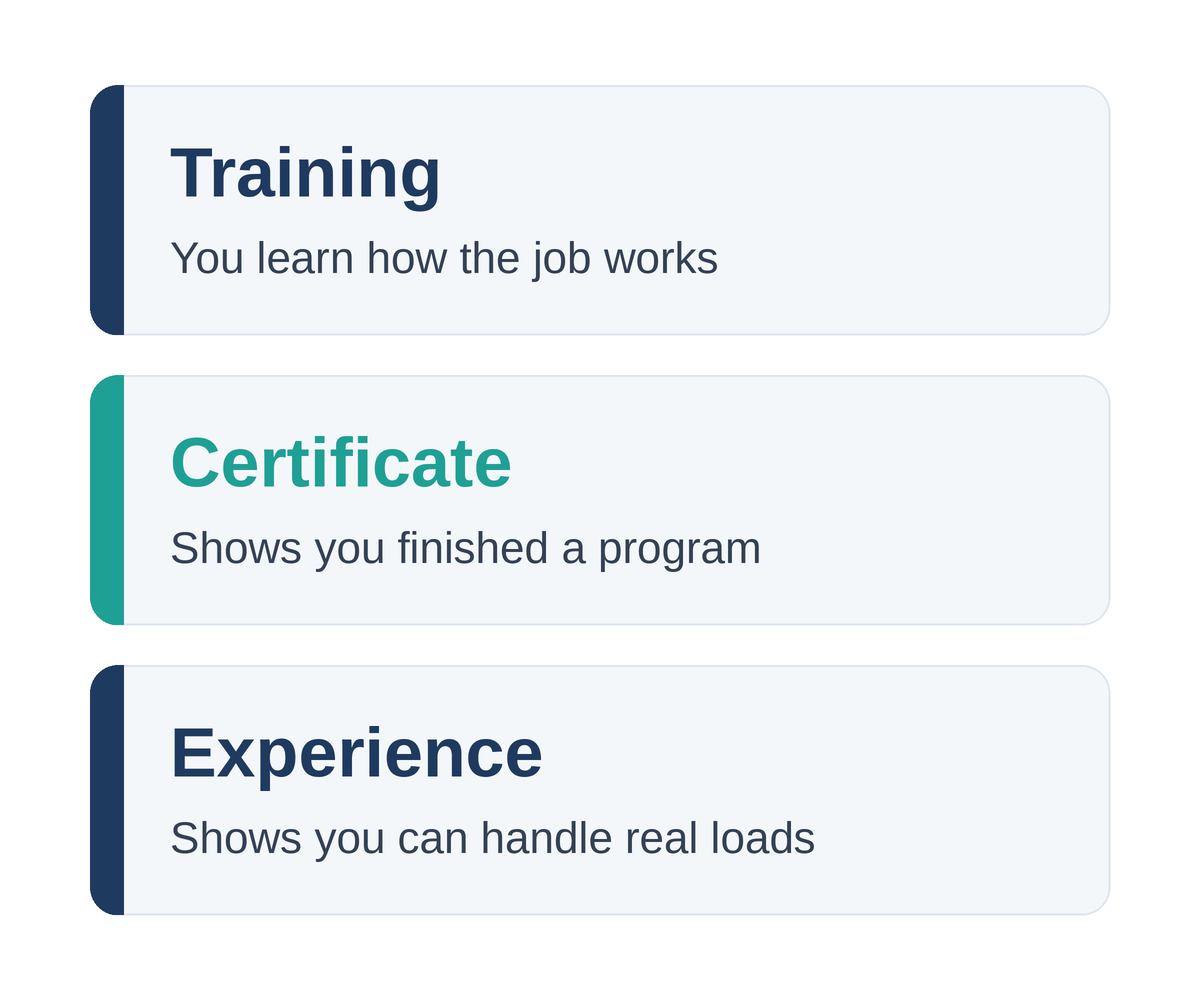
A dispatcher certificate is issued by whoever runs the course, not by the government. It shows you finished a program. It doesn't prove you can book a load, read a rate confirmation, or keep a carrier happy at 6 a.m. when a delivery slips.
That doesn't make it worthless. A good program can shorten the learning curve and give you vocabulary and structure. It just isn't a license.
How to Judge a Training Program
Before paying for anything, look at these things:
What's covered. Load boards, rate confirmations, broker and carrier communication, and paperwork like proof of delivery should be in there. If it's mostly motivation and a sales pitch, skip it.
Who runs it. Look for a real business with a track record you can check, and ignore any impressive-sounding name that can't be verified.
Promises about income. Be wary of any course that guarantees what you'll earn.
Cost and refunds. Know exactly what you're paying and what happens if it isn't a fit.
Free options first. Plenty of people learn the basics before spending anything. Our guide to free truck dispatcher training covers where to start, and online truck dispatcher courses compares the paid route.
What Carriers Actually Look For
Owner-operators and small carriers rarely ask to see a certificate. They care whether you answer quickly, find decent loads, communicate clearly with brokers, and keep their paperwork straight. A track record of a few well-handled loads and a couple of references will do more for you than any credential, and a simple system for tracking loads, documents, and payments helps you show your work from day one.
FAQ
Do I need a certification to work as a freight dispatcher? No. There's no legal requirement to hold one to dispatch. Some employers or training programs may prefer or offer one, but it's optional.
Do I need a CDL? Generally no, because dispatchers coordinate loads rather than drive them. Some carriers like dispatchers who understand driving, but it isn't a requirement for the job.
Do I need a broker license to dispatch? Not for ordinary dispatching on behalf of carriers. A broker license applies when you act as a broker, arranging freight between shippers and carriers. If your arrangement is unclear, confirm with the FMCSA or an attorney.
The Bottom Line
You can start without a certificate. What you can't skip is learning the work and handling real loads well. Take a course if it helps you learn faster, but judge it by what you'll be able to do afterward, not by the paper at the end.